

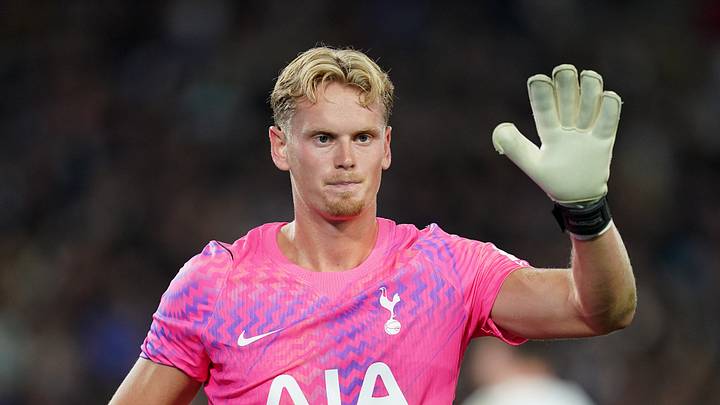
So goes the legend of Antonin Kinsky: An injury crisis in the 2024/25 season compelled Tottenham Hotspur to buy the young Czech goalkeeper from Slavia Prague . He made 10 unremarkable appearances. Last season, he sat firmly on the bench behind Guglielmo Vicario until, inexplicably, interim manager Igor Tudor started Kinsky in the Champion League knockout rounds against Atletico Madrid. Kinsky allowed three goals, two of them on horrid mistakes, and was pulled in the 17th minute. He was redeemed when, filling in for an injured Vicario, he helped save Tottenham from relegation with excellent performances during the run in. Now, Kinsky is the presumed first-choice keeper heading into the 2026/27 season.
His is a fun, satisfying story, but there remains an open question. Is Kinsky actually good?
Much of the post-Atleti coverage focuses on the qualitative. “Roberto De Zerbi forces you to believe in yourself,” The Athletic recently quoted Kinsky. “I would say I'm stronger by [the Atleti] experience,” Kinsky told Sky Sports in May. That’s nice, but no amount of belief and strength will allow me to block shots in the Premier League. I must have the requisite skills, and on this point Kinsky’s quality is evasive.
He doesn’t have enough minutes to form a useful radar, so quantitative analysis and comparison is difficult. One stat that is available, save percentage, isn’t promising. In Premier League action last year, with all of it occurring in the stretch run, Kinsky’s save percentage was 58.8%. That is dreadful, and it flies in the face of conventional wisdom, which holds that Kinsky’s shot stopping saved Spurs from relegation.
Indeed, Leeds United accrued 1.61 expected goals on target against Tottenham in their May 11 matchup. Leeds’ only goal came on a penalty, and the game ended in a 1-1 draw, meaning Kinsky’s incredible saves in that game denied Leeds at least one more goal and staved off a catastrophic loss for Spurs. According to Opta Analyst’s xGOT model, only 14 goalkeepers prevented more goals in a Premier League game last season. Additionally, Kinsky conded only five goals in seven Premier League games, which, over a full season, would have placed him among the league leaders in goals conceded per 90 minutes.
It’s a mixed bag, then, and so it is with Kinsky’s other ballyhooed skills in distribution and passing. Kinsky flashed those skills in a preseason performance against Chelsea, but ball handling errors defined Kinsky’s disastrous performance against Atleti. As recent as last week, Tottenham manager Roberto De Zerbi acknowledged Kinsky has much to improve on in build-up play.
At this stage of Kinsky’s career, the best way to assess him is to say he is not Vicario. That’s what Opta Analyst did when analyzing Kinsky’s performance against Leeds. “[Kinsky’s] case is strengthened, too, by Vicario’s wildly disappointing numbers, the Italian ranking bottom of the entire Premier League this season for goals prevented (-5.5), having conceded 50 goals (excluding own goals) from 44.5 xGOT.”
It’s not exactly a ringing endorsement when the case for Kinsky is basically at least he’s not that guy, especially when that guy had a better save percentage than Kinsky.
There is no doubt that Kinsky is not as bad as he showed against Atleti. His saves at the end of the Premier League season proved he has real skill in stopping shots. But the redemptive arc foisted upon him belies the fact that, as of now, no one really knows if he’s cut out for a 38-game season in the Premier League. And behind Kinsky is a 37-year-old Martin Dubravka, who last year participated in the slow-motion trainwreck that was Burnley.
There is a lot of talk about Tottenham’s new direction, what with their major signings this summer, but it appears they need reminding that hope is not a strategy.
 Add us as a preferred source on Google