

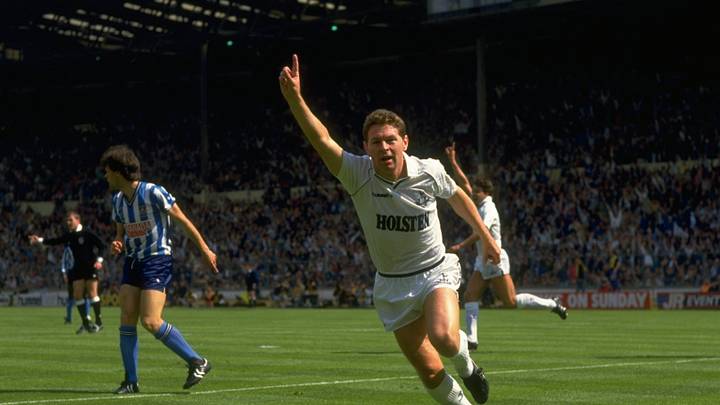
The 1980s saw some memorable success for Tottenham, particularly in the first half of the decade. There were FA Cup wins in 1981 and 1982, and a UEFA Cup (the forerunner of the Europa League) win on penalties in 1984. Our teams typically played with an attacking flair, and while success dropped towards the end of the decade, we maintained a playing style that looked to attack. We were typically stronger going forward than defensively.
This team includes a legendary English goalkeeper, versatile defenders, a midfield that is all playmakers (so while tackling might not be a strength, the opposition may not even get the ball from these four in the first place), and two strikers with outstanding positioning and finishing.
Goalkeeper: Ray Clemence
Was part of the dominant Liverpool teams throughout the 1970s, Clemence signed for Tottenham in 1981 and continued his outstanding consistency. It was not common for goalkeepers to play the ball out from the back at this time, kicking it long or picking up back passes was more the style. Clemence, however, was talented with the ball at his feet and is often considered one of the first “sweeper-keepers” in the English game. Superb reflexes, positioning, and agility made him one of the best around.
Right Back: Danny Thomas
Provides rapid pace and an attacking threat from right back. After signing from Coventry, his time at Spurs was unfortunately restricted due to injuries. Produced an excellent performance in the 1984 UEFA Cup final, despite missing a penalty in the shoot-out. While Steve Perryman isn’t considered due to his inclusion in the 1970s team, Thomas gives excellent balance to the defense with Hughton on the other flank.
Left Back: Chris Hughton
Spent most of his career at Tottenham and was a highly consistent full back throughout. Although a naturally right-footed player, Hughton was capable on playing on either flank and often played at left back. Was very solid defensively but also excelled going forward, providing overlapping runs and crosses at a time when it was not so common for full backs to do so.
Center Back: Graham Roberts
Captained our 1984 UEFA Cup winning team and scored in the second leg. Roberts was a tough-tackling defender who was also a threat going forward. He could play in midfield and once scored a hat-trick in a game against Southampton. It was his strong defending he was more known for though and he would be more than a match for any striker, particularly at a time when the more physical aspect of the game was more prominent than it is today.
Center Back: Gary Mabbutt
Played for Tottenham through most of the 1990s as well, and as such was his consistency through the years, he could have made that team instead. Like Roberts, Gary Mabbutt also played in midfield at times but is mostly remembered as a center back. Became captain in the late 1980s and held that for many years into the 1990s. Our great 1986-87 season ultimately is remembered as a “nearly season”, but Mabbutt’s center-back partnership with Richard Gough at that time was one of the best we have seen.
Midfield: Glenn Hoddle
Arguably Tottenham’s best ever player, and one of England’s greatest, too, Hoddle possessed a touch and range of passing that was unmatched. Not only was he able to execute passes others would not try, his outstanding vision on the pitch also allowed him to see passes that could be made well before anyone else. Had an uncanny knack to be able to chip the ball with accuracy. Also, scored many memorable goals, with his final goal for Spurs being a particular highlight. Running through defenders, selling the keeper with a dummy and tapping the ball in was the perfect way for Hoddle to sign off before a successful move to France with Monaco.
Midfield: Chris Waddle
Another player who excelled for Spurs before a transfer to the French league. Signed from Newcastle, Waddle scored twice on his debut and did not look back. As well a thunderous shot, Waddle’s dribbling ability was a constant threat to opposition defenders. Seemed to perfect the step over, so that even when defenders knew what was coming, they could not stop it. Even in the seasons where we struggled, Waddle was a consistent attacking outlet and a player who would have fans out of their seats.
Midfield: Ossie Ardiles
Signed after the 1978 World Cup at a time when signing world cup winners was not common in the English league. Ossie always seemed to be in control of the ball, gliding around the pitch and often looking a tier above most others. Players who can dictate the tempo of a game on their own are rare, but Ossie could do this effortlessly. We probably did not have anyone who could do this after Ossie until Luka Modric was signed in 2008. Later had a spell as a manager where he introduced some pioneering ideas. These had initial success but unfortunately not long term, however many of these tactics are used by teams today.
Midfield: Paul Gascoigne
Another signing from Newcastle, Gascoigne could be in either team of the 1980s or 1990s. Very difficult to get off the ball once in full flow, he dribbled past defenders with ease. A player who was impossible to predict, Gascoigne would try the outrageous or the ridiculous at any time. Scored many memorable goals, including 4 goals in one game in a league cup tie. Was adept at free kicks and his most famous goal (although in the 1990s) came with a particularly stunning one. A long-distance free kick against Arsenal in the FA Cup semifinal at Wembley.
Striker: Steve Archibald
A key part of our success in the first half of the 1980s, Archibald was a reliable goalscorer and was the division’s overall top scorer in his first season with the club. Excelled at reading the game and finding the right position to score, but also combined this with a strong work rate, often creating space for others. Add in his strong hold-up play and instinctive finishing, Archibald was an all-round striker. At a time when playing two strikers was common, he had productive striker partnerships with both Garth Crooks and Mark Falco. Went on the join Barcelona where he won La Liga.
Striker: Clive Allen
Part of a famous footballing family, which includes, among others, Clive’s father Les Allen (part of our 1961 double-winning team) and Clive’s cousin Paul Allen (who also played for Tottenham during the 1980s). Clive Allen was signed from Queens Park Rangers and scored twice on his debut in 1984. A predatory striker, Allen was a lethal finisher and scored goals consistently. His most famous season was 1986-87 where he was unstoppable. Allen scored 49 goals that season, 33 in the league and another 16 in the two domestic cup competitions, which is still a record for Tottenham.
 Add us as a preferred source on Google